


Page 19 - PT Winter 2021-2022
P. 19
So what does this mean for churches? Well, older people
        value facilities such as handrails they can cling to; they
        prefer slopes to steps; toilets not too far away; non-slip
        floors; and a place to put their sticks when sitting down and
        a comfortable seat (ideally with a cushion!).
          Churches will need to cater not just for more older
        people, but in the years ahead more ‘older, older’ people.
        There were 88,000 people 85 and over going to church
        throughout England in 2010, but a decade later 140,000,
        reflecting an increasing rate of 5% per year.

        Adapting in old age?
        And what does this mean for the older people themselves?
        Book your place in your care home quickly if you need to!
        Funerals will become more frequent; if you can’t attend,
        watch on a laptop or smart phone, and if you don’t have
        one, get a device and learn to use it as quickly as you can.
          While many churches are claiming more people are      ...as churchgoers become
        watching their live-streamed services than used to attend
        personally, it is also clear that live-streamed services are   older, their feeling of
        simply not the same as person-to-person meetings.
          Live-streamed services have become a sort of another   belonging to a church
        Songs of Praise – to watch but not participate. While it may
        be easy to ‘drop out,’ it is important for a person’s well-  grows less.
        being to continue being able to ‘connect-in’.
          So what does all this mean for church leaders?
        Helping people to retire – for some the loss of work,
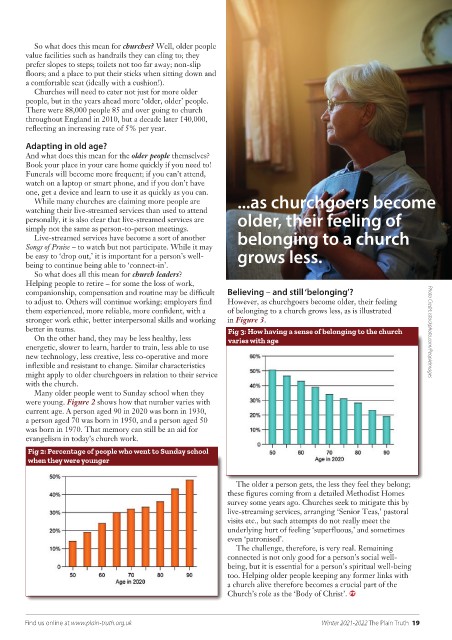
        companionship, compensation and routine may be difficult   Believing – and still ‘belonging’?
        to adjust to. Others will continue working; employers find   However, as churchgoers become older, their feeling
        them experienced, more reliable, more confident, with a   of belonging to a church grows less, as is illustrated
        stronger work ethic, better interpersonal skills and working   in Figure 3.
        better in teams.                                     Fig 3: How having a sense of belonging to the church   Photo Credit: istockphoto.com/PeopleImages
          On the other hand, they may be less healthy, less   varies with age
        energetic, slower to learn, harder to train, less able to use
        new technology, less creative, less co-operative and more
        inflexible and resistant to change. Similar characteristics
        might apply to older churchgoers in relation to their service
        with the church.
          Many older people went to Sunday school when they
        were young. Figure 2 shows how that number varies with
        current age. A person aged 90 in 2020 was born in 1930,
        a person aged 70 was born in 1950, and a person aged 50
        was born in 1970. That memory can still be an aid for
        evangelism in today’s church work.

        Fig 2: Percentage of people who went to Sunday school
        when they were younger


                                                               The older a person gets, the less they feel they belong;
                                                             these figures coming from a detailed Methodist Homes
                                                             survey some years ago. Churches seek to mitigate this by
                                                             live-streaming services, arranging ‘Senior Teas,’ pastoral
                                                             visits etc., but such attempts do not really meet the
                                                             underlying hurt of feeling ‘superfluous,’ and sometimes
                                                             even ‘patronised’.
                                                               The challenge, therefore, is very real. Remaining
                                                             connected is not only good for a person’s social well-
                                                             being, but it is essential for a person’s spiritual well-being
                                                             too. Helping older people keeping any former links with
                                                             a church alive therefore becomes a crucial part of the
                                                             Church’s role as the ‘Body of Christ’.


        Find us online at www.plain-truth.org.uk                                      Winter 2021-2022 The Plain Truth    19

