
Protecting girls and young women
in the digital age


By Judith Davey-Cole
CEO of The Girls’ Brigade England & Wales
When Ofcom reported that 96% of children aged 3 to 17 were online in 2024, it confirmed what most parents and youth leaders already knew: the digital world is no longer optional. It is the air our young people breathe. And while the internet offers extraordinary opportunities for connection, learning, and creativity, it also harbours dangers that disproportionately target girls and young women.
At Girls’ Brigade, we see both sides of this reality every day. Online platforms can be lifelines for young carers who cannot leave the house, or for those in rural areas where youth groups are out of reach. Digital spaces allow us to extend friendship, fellowship, and faith to those who might otherwise be isolated. But they also expose girls to relentless pressures, toxic role models, and gender-based abuse that corrodes self-worth and mental health.
The statistics are chilling

Three quarters of girls and young women aged 7–21 report experiencing online harm. Reports of sextortion involving girls rose by a staggering 2,600% in 2024, with victims as young as 11. Eighty-one per cent of victims in over 7,000 offences of sexual communication with a child were girls. The statistics are ‘Elise’, a member of Girls’ Brigade, who battled eating disorders and low self esteem amplified by social media before finding strength in her faith. They are Caro, who wishes she had the support of Girls’ Brigade as a frightened teenager and is now a GB volunteer so that others don’t have to go what she went through.
We must name the problem clearly: misogyny has moved from the margins into the mainstream. Influencers with millions of followers openly devalue women and girls, and research shows that teenagers exposed to this content are five times more likely to believe that hurting others is acceptable. This is not just a cultural issue – it is a moral crisis and as Christians must concern us deeply – these are not Kingdom values.
So, what is to be done? The simplistic advice to ‘just log off’ doesn’t cut the mustard. For some young people, online engagement is not a luxury, but a lifeline.
Education and awareness are key. At Girls’ Brigade, we run programmes such as Staying Safe in the Digital World where we explore questions such as: What is truth? How do you know whether the images and posts you see are real or whether they’ve been enhanced? We then contrast this with biblical truth. And, of course, we teach them how to question: How do I know whether this is real? How can I check? Teaching children and young people to go beyond face value, think carefully, and question more deeply is a critical life skill for 2026 and beyond.
Legislation must have teeth
The UK’s Online Safety Act rightly identifies harmful content, from pornography to self harm instructions, as ‘Primary Priority.’ However, enforcement remains a challenge. Age verification is notoriously difficult. Tech firms must be held accountable for the content they host. Compassion, as Tim Berners-Lee, the inventor of the World Wide Web, recently reminded us, must be built into the very architecture of the internet.
Faith communities have a vital role to play. Churches and Christian youth organisations must educate, advocate, as well as provide safe spaces for young people. It’s a missional priority for us as Christian communities to have open discussions about both the benefits and downsides of being online. It is hugely important to talk to children and young people about the dangers of engaging with others online – they might think they are talking to another 12-year-old, but the reality might be very different. It is also vital for them to understand who they can contact if they’re worried about anything or experiencing anything they’re uncomfortable about.
Trusted adults – whether parents, teachers, or youth leaders – are indispensable. Sometimes children prefer not to confide in parents or teachers, because they’re worried about the potential consequences. This emphasises the importance of trained, safely recruited volunteers in Christian youth organisations like Girls’ Brigade and the crucial role they play. Not every child has a supportive family, but every child deserves someone who will listen, guide, and protect.
Limiting screen time and locking down devices, reducing the possibility of people you don’t know from contacting your children is a good idea, but this must be reinforced with education and awareness. And we all need to be role models and exercise good practice by taking regular breaks from our own devices and spending time doing healthy and spiritually nourishing things instead.
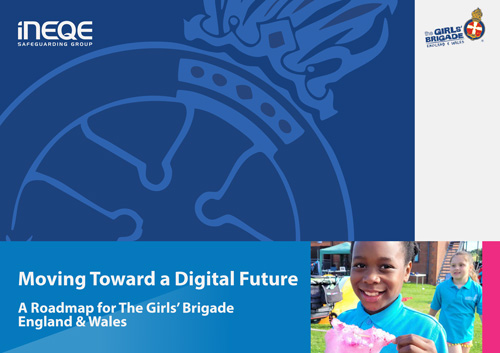
This report, published by ineqe Safeguarding Group for The Girls’ Brigade England & Wales, presents an assessment of the contemporary digital landscape, addressing critical issues facing girls and young women, such as AI-generated abuse, sextortion, grooming, and body image. (Click on the image to download a copy from the The Girls’ Brigade website.)
It provides actionable recommendations designed to guide responsible digital activity, detailing how The Girls’ Brigade can align its digital youth work with any of the Department for Education’s proposed safeguarding approaches for Out-of-School settings, creating safe digital spaces that set a standard for the wider youth sector.
Done well, online youth work can itself be a protective factor. It can build digital resilience, nurture trusted relationships, and create safe spaces for support and belonging. The Girls’ Brigade is well positioned to achieve this and is committed to ensuring safeguarding shapes every aspect of digital provision – from planning and training through to delivery and governance.
At The Girls’ Brigade, we see a great opportunity to engage young people in thinking critically and faithfully about their digital lives – helping them to stay safe and be a positive influence on the world. The digital age is here to stay. The question is whether we will allow it to erode the dignity of girls and young women, or whether we will rise to the challenge of shaping it with compassion, wisdom, and faith. At The Girls’ Brigade England & Wales, we choose the latter. And we invite you to join us.
Visit our website for more information: https://www.girlsbrigadeministries.org.uk
Judith Davey-Cole is the CEO of The Girls’ Brigade England & Wales. Judith has many years of experience in the leadership of organisations across public, private, and charity sectors, and has a proven track record of enabling major strategic, cultural, and organisational change, delivering impact cost-effectively, and engaging stakeholders to build consensus and momentum.